Favorites

Tuesday, May 30, 2017

Open Letter to Artists | No Fee Art Submissions

Dear Artists,
 
We are in the process of making several major changes and I am anxious to tell you about them.

First, artists who submit work in response to our calls will no longer have to pay fees
. Everything else about our exhibitions will stay the same. We will select thirty artists whose work will be shown online and in our art and literary journal, Still Point Arts Quarterly, and we will designate 5 artists as award winners in 5 categories.
Second, we have decided to transition to a digital interactive journal; eventually, we will stop producing our journal in print. This decision was mainly driven by difficulties we've had with the U.S. Postal Service regarding delivery. We've made several changes over the years to try to improve our delivery rates, but we still experience a number of costly delivery problems with every mailing. For a small business, these expenses can be very troubling. Some of you have experienced this problem with us. So, we've decided to focus our efforts in the future on our digital piece, and we plan to make it an interactive digital publication with links and pop-ups. We're excited about the next steps in the evolution of our very fine art and literary journal. Also, we will continue to honor paid subscriptions to print editions until they expire.
Still Point Arts Quarterly

Third, subscriptions and single copies of our digital publication will be free. With our expenses drastically lowered by not paying printing and mailing costs, we feel we can offer our journal to readers at no cost. Ultimately, our goal is to dramatically widen our reach into the art and literary community. 


Sign up for your free digital subscription to Still Point Arts Quarterly, which starts with the fall 2017 issue.

I know there is a feeling on the part of many artists that the practice of paying money to have one's work considered for an exhibition is questionable, at best. While it is a very common practice, it has both pros and cons, and I have often given this consideration. But the business of producing a print journal has required us to find ways to support the ever-increasing costs of printing and postage. Since our artists are featured in the journal, I felt charging fees was justified. But by now dropping our printing and mailing expenses, it only makes sense to not charge fees for submitting artwork for consideration. 

I hope you will continue to support and delight us with your art submissions. Our commitment to quality content and presentation is unchanged. Please share this message with your friends and colleagues.

Thank you for all you do to make our work so enjoyable.
Hope to hear from you soon.

Christine Cote
Founder and Proud Member

Wednesday, May 25, 2016

Rare Literary Achievement Available Again


Shanti Arts Publishing announces the release of Bob Thurber's debut novel, Paperboy: A Dysfunctional Novel. Paperboy was first published by Casperian Books in 2011 and went out of print a few years later. The book's popularity and superb reviews led to its republication by Shanti Arts Publishing. It is due to be released May 31, 2016.

Paperboy is the story of fourteen-year-old Jack Fisher-malnourished and battered, abandoned by his father, neglected by his mother, manipulated by his older sister, harangued by his boss, and shortchanged by customers. Jack delivers papers in Pawtucket while trying to keep his family from self-destructing completely. It is 1969, and as the whole world holds its breath to see what will become of the Apollo 11 astronauts, Jack clings to his daily mantra, "Things will get better." But things get drastically worse, at space-age speed.

Bob Thurber is an award-winning short story writer whose fiction has appeared in hundreds of publications and dozens of anthologies. Born in Pawtucket, Rhode Island, in 1955, he experienced poverty, a lack of formal education, and a series of dull dreary jobs while working obsessively at writing nearly every day for twenty years before attempting to publish his work. Since then he has produced an enormously successful body of work that has received a nearly endless list of awards and citations. Thurber is also the author of Cinderella She Was Not (2013), Nickel Fictions: Volume One (2013), and Nothing But Trouble (Shanti Arts Publishing, 2014).

Paperboy has received much praise from authors, reviewers, and editors. The literary website Three Guys One Book wrote: "Reading this book, even at its darkest places, you can see Bob Thurber's fingerprints. He's so sharp-especially at short fiction-that he writes short burning chapters from which you can't tear away. He slugs you right in the gut without any maudlin posturing-you'll probably ask for more. Raw and horrific throughout, but genuinely funny in places."

Author Dennis Must said: "Paperboy continues to haunt my consciousness. The narrator's skill and veracity in this pared-down and guileless rendering I consider a rare literary achievement."

Paperboy: A Dysfunctional Novel is a publication of Shanti Arts Publishing in Brunswick, Maine. The book may be purchased through all major online booksellers and may be found in select bookstores. A digital edition is available through most sellers of ebooks.

ISBN: 978-1-941830-34-5 (print, softcover) $17.95 USD
ISBN: 978-1-941830-35-2 (digital) $3.99 USD

more information

Monday, April 11, 2016

Bob Thurber's Reflection on Writing


Something for our writers . . . 


Remember . . . Keystrokes are hammer taps. Get words on paper. Don’t worry about connections, character or plot. Work for an hour. Promise yourself an hour. Do nothing else but move your fingers. Make coarse shapes. Follow any emotion that pops up but never impose emotion, never fake it, and don’t make up your mind or your heart ahead of time. Understand you don’t know what you’re doing. That’s why you’re here. Rough it out. Anything goes. You can decide later what any piece of text looks like, what it might mean. Don’t stop. Don’t question. Don’t quit. Don’t stop to read what you wrote. Move your fingers. You mind will have no other option but to keep up. Remember that writer’s block is merely the cold marble waiting for the chisel to heat up.

Bob Thurber, author of Paperboy and Nothing But Trouble (Shanti Arts Publishing, 2014) and countless short stories and flash fiction.


Note: Shanti Arts Publishing is republishing Paperboy and it will be released later this spring. When I read Paperboy a few years ago, I was stunned and amazed. It's a book I've never been able to get out of my head. When Bob asked us to republish it, I was elated. I'm delighted to make this book available again.

Tuesday, August 18, 2015

Diana Crane Awarded 2015 Write Well Award

Diana Crane has received the 2015 Write Well Award  for her story, "The Visitor," which appeared in the Winter 2014 issue of Still Point Arts Quarterly.  

The Write Well Award was established by the Silver Pen Writers Association, a non-profit organization that encourages and fosters creative writing careers, and is named after the Write Well, Write to Sell blog by Rick Taubold and Scott Gamboe, also a part of Silver Pen. The award seeks to recognize excellence in published short fiction in both print and electronic magazines. 


Diana Crane grew up in Canada, taught sociology in the United States, and has published several books of nonfiction on topics related to fashion, the media, and the arts. She has been the recipient of a Guggenheim Fellowship and twice the recipient of a Fulbright award. She now lives in Paris where she writes fiction as well as articles about fashion and the arts. She also co-edits a fashion studies journal.

Please click here to read "The Visitor."

Images in this story are by Susan Landor Keegin.


Wednesday, June 03, 2015

Spring Rain Winter Snow Honored by the Haiku Society of Ameria


We are delighted that our children's book Spring Rain Winter Snow received an Honorable Mention in the annual book awards by the Haiku Society of America. The haiku in Spring Rain Winter Snow are by Edward J. Rielly, and illustrations are by Angelina Buonaiuto. 

Spring Rain Winter Snow celebrates the four seasons with insightful haiku and enchanting illustrations. The pages of this lovely book are filled with opportunities for children to gaze, wonder, question, and smile. Both children and adults will enjoy this book for its engaging approach to the magic of nature's seasons.


JUVENILE NONFICTION / Concepts / Seasons
JUVENILE NONFICTION / Poetry / General

ISBN: 978-1-941830-94-9 (print; hardcover) $19.99

More Information  |  Purchase


Samples pages:


Thursday, May 28, 2015

Three Writers Nominated for Write Well Award

Three featured writers have been nominated by Shanti Arts for the 2014 Write Well Award, which seeks to recognize excellence in published short fiction in both print and electronic magazines. Winners will be announced in August 2015.

Nominated writers are:

Diana Crane, for "The Visitor," which appeared in the Winter 2014 issue of Still Point Arts Quarterly

Diana Crane grew up in Canada, taught sociology in the United States, and has published several books of nonfiction on topics related to fashion, the media, and the arts. She has been the recipient of a Guggenheim Fellowship and twice the recipient of a Fulbright award. She now lives in Paris where she writes fiction as well as articles about fashion and the arts. She also co-edits a fashion studies journal.
Crane's website | Amazon page


Frederic Smith, for "The Old Man and the Ballerina," which appeared in the Winter 2014 issue of Stone Voices.

Frederic Smith is a southern Californian who went to Princeton and Cambridge. Twenty years ago he tired of practicing law and turned full-time to writing. He is the author of numerous stories and a novel, See How We Run, which received the lead reviews in the New Statesman and the Irish Times.  


Susan Scott, for "Still Life," which appeared in the Spring 2014 issue of Stone Voices
Susan Scott collaborates with artists, scholars and activists on a wide range of creative projects and serves as a lead editor with New Quarterly magazine, home to the Wild Writers Festival in Waterloo, Ontario, Canada. Scott teaches memoir, short fiction, and the well-wrought essay; 2014 workshops include the annual French River Creative Writing Retreat and Stone by Stone: Writing Spiritual Memoir, with Prajna of Amida Mosaic Sangha. A memoir in-progress, Sainted Dirt: Stories from the Fringe, explores the gifts of spiritual displacement. A chapbook, Temple in a Teapot, was launched on the Mormon Women Writers Literary Tour.

Monday, April 13, 2015

Loving Awareness

Lukas Riebling, Flaming Heart.

How does one become loving awareness? If I change my identification from the ego to the soul, then as I look at people, they all appear like souls to me. I change from my head, the thought of who I am, to my spiritual heart, which is a different sort of awareness — feeling directly, intuiting, loving awareness. It's changing from a worldly outer identification to a spiritual inner identification. Concentrate on your spiritual heart, right in the middle of your chest. ~ Ram Dass

Tuesday, March 17, 2015

Let go of it?

One cold day a bearskin was floating down the river.
I said to a man who had no clothes,
"Jump in and pull it out."
But the bearskin was a live bear,
and the man who jumped in so eagerly
was caught in the clutches of what he went to grab.
"Let go of it," I said, "Fighting won't get you anywhere."
"Let go of it? This coat won't let go of me!"

~ Rumi, "The Pull of Love"

A Bear Fighting a Tiger, 1610

Thursday, March 12, 2015

Leonard Cohen: He's My Man


I've rediscovered Leonard Cohen....he's my man.


"I generally find the song arises out of the guitar playing, just fooling around on the guitar. Just trying different sequences of chords, really, just like playing guitar every day and singing until I make myself cry, then I stop. . . . I don't weep copiously, I just feel a little catch in my throat or something like that. Then I know that I am in contact with something that is just a little deeper than where I started when I picked the guitar up."

Wednesday, March 04, 2015

An Afternoon with Bergman - Ingmar Bergman

As editor of two art and literary journals, I have the pleasure of reading an amazing variety of submissions—gripping stories, inspiring characters, surprising endings. Of those pieces that are selected, I then have the delight of putting them in layout, which involves doing a very close read and creating the visual display, the "look and feel," that will enhance the telling of the story and the delivery of the message.

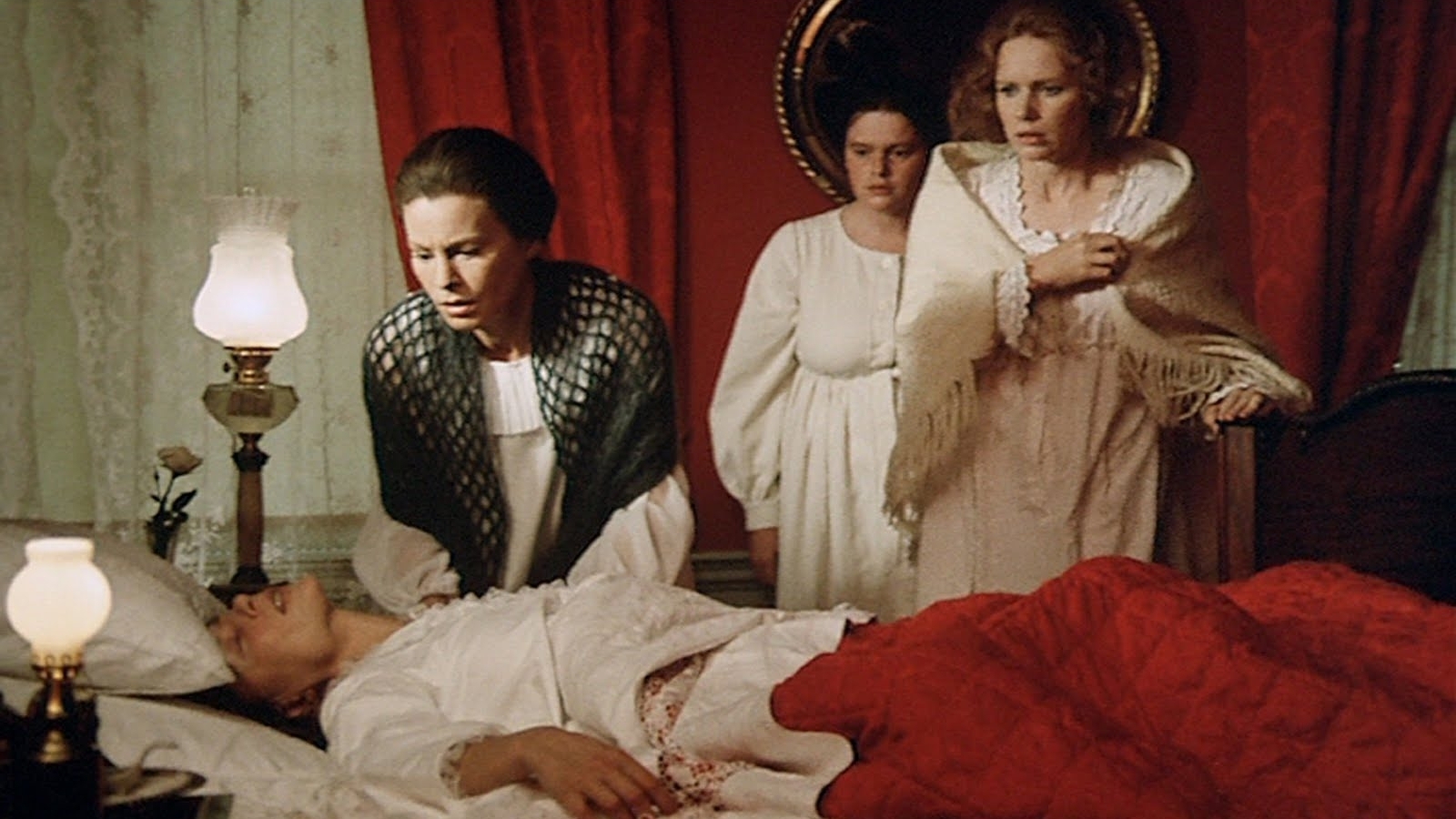
Today I had a very special treat. I was working on a piece that will appear in the upcoming summer issue of Stone Voices. Called "I'm Anxious, Mr. Bergman," by Leo Tracy, its story is entwined with that of the 1972 Ingmar Bergman film Cries and Whispers.

Tracy tells the story of a young man dealing with searing questions about life, love, joy, destiny, cruelty, and death. His internal struggle is made even more difficult because he is gripped by anxiety and OCD. While visiting his uncle, the young man goes to see Cries and Whispers—not ever an easy movie to watch, but far less easy while gripped with emotional fragility. As for me, a close read of this piece made me determined to see Cries and Whispers. So I checked Hulu for availability . . . and there it was.

The film tells the story of three sisters, one of whom is dying of cancer. Through flashbacks, the problems of the family are revealed: infidelity, jealousy, arrogance, and even hatred. This makes dealing with the death of a sibling extremely difficult. Only the family maid is able to comfort and care for the dying woman and does so out of genuine love and affection.

The film is a thing of beauty. Costumes and furnishings are splendid. Poses, postures, and facial expressions of characters are precise and expressive. The flow of the film is slow and serene, but also perfect; one can't rush through the kind of emotional spectacle presented here. Adding to the drama, the color red is used to punctuate scene changes and certain highly emotional moments. It is a memorable and complex creation.

"I'm Anxious, Mr. Bergman" is ultimately about the intertwining of life and art. We bring ourselves to art, our anxiety, sorrow, desperation, as well as joy, freedom, and sense of fulfillment. If we are open and engaged, art helps us churn through all the muddled pieces of our lives. Sometimes art is enjoyable and refreshing; sometimes it tears us wide open. But do it, we must. 

Sunday, November 23, 2014

David Denny Nominated for the Pushcart Prize

Shanti Arts is delighted to announce that it has nominated David Denny for the Pushcart Prize for his story "Gravidation," which appeared in the spring 2014 issue of Stone Voices.

David Denny is the author of Fool in the Attic (Aldrich Press), Plebeian on the Front Porch (Finishing Line Press), and the forthcoming Man Overboard (Wipf & Stock). His poems and short stories have appeared in numerous literary journals, including Sand Hill Review, California Quarterly, Iodine Poetry Journal, Pearl, and The Sun. He holds an M.F.A. in creative writing from the University of Oregon and an M.A.T. degree from Fuller Theological Seminary. Denny is Professor of English at De Anza College and former editor of Bottomfish magazine. 

Read "Gravidation."


Friday, November 21, 2014

The Elements of Art

I recently started reading The Daily Book of Art, a collection of 365 short readings about lots of different facets of art. The first reading is about the elements of art—line, shape, texture, etc. I've seen these referred to as the building blocks of art, as if we use them one-by-one to put together a work of art. But I think art-making is largely intuitive; it's probably not all that common for an artist to consciously think about line and shape and texture while making art. These elements of art, however, come into play when we step back to review, analyze, or interpret a work of art. They give us a common language that helps us understand art.

The first entry in The Daily Book of Art says to imagine the elements of art as components of a visual language. Surely I've heard this before, but it jumped off the page today and made me ask myself: If the elements of art are a language, what is my art saying? 


This is one of my favorite images, taken a few years ago on the shore of a lake in northern Maine. Looking at it now and thinking about art as visual language, I can see that this image is saying quite a lot. If I focus on texture, I see gentle ripples on an otherwise calm water surface covered with a shroud of mist that contributes to the calm and gentle feeling of the scene. Then there is the clear horizontal line signifying the movement of the ducks from left to right, breaking the stillness of the water, creating a crease of evidence that stays for only a few minutes and then disappears. Then there is the rock, a critical part of this composition. Without the rock, this would be an entirely different image. The rock is the counterpoint, a hard and edgy shape amidst an ocean of soft mist and calm water.

So what is this image saying? I think it is saying something about the general state of stillness, a state unencumbered by passing thoughts and solid impediments. This image evokes such a state and honors it. But, somehow, putting this into words doesn't work all that well. The image says what I have to say so much better than the words. And the most amazing part is that I wasn't consciously thinking about this when I took the picture; rather, the scene resonated with me in a very strong way and I was drawn to preserve it. By making this picture, I used the elements of art to make a statement—one that can't as easily be said with words, at least not by me.


Thursday, November 06, 2014

Listen

A person's too weak to trust his own head, she told him. When you're in trouble, she said, don't listen to what your mind says. Listen to the faint voices outside of yourself—stones rattling at the bottom of a creek, the rustle of leaves. There's messages out there if you know how to look. There's more meaning in an owl's cry than in a shelf full of Bibles. Watch what the fish are biting, study how a dog sleeps, remember where the dragonflies gather to drink from the mud. 
Vincent Louis Carrella, Serpent Box


Tuesday, October 28, 2014

Serpent Box: A Book with a Soul

Serpent Box, a novel by our own Vincent Louis Carrella, who writes a column for Stone Voices, has been on my reading pile for a few years now. Earlier this month, while getting ready to head out to spend a few weeks in the north Maine woods, I snatched it from its temporary resting place and put it in my bag. It was a great decision.

The book is a gem. I love a book with a soul, a book whose words wrap themselves around me in a tight embrace and won’t let go, a book that greets me in the morning while I’m sipping tea, and a book that provides me with my last thoughts before falling asleep for the night. Serpent Box has a soul. Here's a snippet:


Baxter once said that a man in the woods was about the purest thing there was in the world, and the closest he could come to knowing God. A man can never buy with money this thing that the Lord gave him for free, he said. That sense of awe and respect one derives from the trees and the earth and all things that dwell in between them. He told Jacob that poetry was all around him, in the grass and on the surface of the leaves, and that the Bible was full of good words designed to mimic what could never be written, but could sometimes be heard and always seen—the rising water, the falling rain, the rush of river and wind, the passage of cloud banks and great ruminant herds, buffalo and elk and the trailing packs of carnivores, both man and wild dog, wanderers all, in endless migration to the grasslands that feed them. He told them that magic is neither myth nor mystery but that which cannot be explained or understood—which is how the world was and should always be. There’s magic in a caterpillar, he told him, and in an acorn and behind the stars. His ancestors had understood this. They worshipped the forest as some white men worship God He had only come to know and love God through time spent in the woods . . . .

Christine Cote
Shanti Arts 

Friday, September 05, 2014

This Is Abstract Art

Still Point Art Gallery's current exhibition is Earth Water Fire Air: Our World in Abstract. Jamie McHugh received the award for Best Photograph for his image, Untitled #17 (2007).

Despite the title, you most likely see this photograph as a picture of a beach and a wave receding back into the ocean. Waves rush rapidly onto the beach, their height and intensity becoming smaller and smaller as they move along. Then, all of a sudden, they begin to recede, leaving traces of water sinking into the sand. This happens over and over and over, and you can sense this rhythmic activity in this image.

Jamie McHugh, Untitled #17 (2007)

But, this image doesn't look like the beach; it doesn't look like the ocean. The "sand" is too yellow, and the "water" is too blue.

So, imagine for a moment that this isn't a beach scene. With your eyes you see little more than color fields of deep yellow and sharp blue meeting up with one another, merging with one another, and a line of tension exists between them. In fact, yellow and blue are known as complementary colors—colors that, when placed next to each other, create strong contrast and serve to reinforce one another. You can see the contrast between these colors in this image, and you can see the way the colors support and even intensify each other. 

Now, try to see this image without your mind. How does the image make you feel? What experiences in your life does it remind you of? Are you the yellow part of this image or the blue? Put the image in motion and, with your body, feel the movement. Notice how you and the image interact. Notice how you and the image can become one. This is abstract art.

Christine Cote
Shanti Arts


Thursday, August 28, 2014

Fall...What a Glorious Season

It's been a good summer...not too hot, not too terribly busy. Time to enjoy everything around me...my new puppy, my beautiful flowering shrubs, the mounds of ferns in the woods, family and friends. But summer in Maine always goes so fast. Spring doesn't seem to end until July 4th, and then by mid-August, the shadows are long, the leaves start turning, and the cicadas are buzzing in the trees—sure signs that fall is almost here. 


Today was a glorious day, the kind of day that ends with a warmth in your heart and a smile of contentment on your face. I got some editing done, worked in my yard pulling weeds and clearing out brush, wrapped some presents and made a cake for my friend whose birthday we will celebrate tomorrow, and sat on the deck answering email and watching my dogs chase each other around in the woods. It was warm, but not too hot, and there was a strong breeze coming out of the northeast that felt so good. I can't count the number of times I said, "It feels like a fall day."


Then, no coincidence, I'm sure, I pulled up the website of one of our artists, Susan Landor Keegin. Susan has exhibited her work numerous times at Still Point Art Gallery, and her work was featured in the summer 2014 issue of Still Point Arts Quarterly. I went to her site today to check the titles of a few paintings that will appear in our upcoming winter issue, and saw this lovely image...


Glorious fall, with its reds and golds, crunchy leaves, cool temperatures, and earthy smells. Pure delight. I easily imagine myself in this splendid landscape, enjoying it with every one of my senses and breathing it into my pores. Fall...what a glorious season. 


Christine Cote
Shanti Arts

Friday, June 13, 2014

Stone Voices Loses Theresa Sweeney

I just received word of the recent passing of Stone Voices columnist Theresa Sweeney. Her mother phoned to tell me that Theresa fell in her home and died from her injuries the next morning. 

Theresa Sweeney
1962 - 2014
A huge shock. A terrible loss. Indeed, the world has lost a voice of wisdom. Theresa's insights into the interconnections between art, nature, and spirit were truly remarkable, and she had a gift for communicating the secrets of these interconnections in a way that was clear and accessible. Her wisdom would sneak up and gently take hold of you while enjoying a story about her grandmother's garden, a trip to Wal-Mart, or paintings of teddy bears. 

Theresa wrote a column for Stone Voices from the very beginning of the publication's history in fall 2011. Her column always offered a powerful message tucked inside a simple, but eloquent, story. Though I never met Theresa in person, I could always feel her radiant personality and vibrant energy when I read her work. So, thinking about her many contributions to our publication over the past few years, I went through her columns and extracted a few paragraphs that I particularly like. Theresa will indeed be missed by the entire Stone Voices community.

----------------

from "Child's Play,"  Summer 2013
It amazes me that in Nature, though every being has a job, no creature appears to work, and yet everything is accomplished. 


from "True Colors," Fall 2013
I remember learning in grade school that when leaves change color they are actually reverting to their original hue. Trees decrease the green chlorophyll in their leaves as they begin to pull energy inward for the coming hibernation of winter. Contrary to what many believe, the vivid shades that hold us spellbound each autumn are really the true colors of leaves. 

The season of fall calls us to reflect upon our own true colors. Like trees, we spend a lot of internal energy creating an artificial chlorophyll-type mask of our own that hides our authentic nature. Many of us grow up feeling insecure in who we are, and in an effort to fit in we sadly stifle our uniqueness. We become attached instead to a false sense of self, dependent upon other people and things to define us. Just as our attention to trees is heightened each autumn when they show us their authenticity, other people's attraction to us is strengthened when we drop our facades and show them who we really are.

Trees have no problem taking self inventory each year and shedding that which no longer serves them. They know that new growth is just around the corner.

As we celebrate Thanksgiving we can be appreciative for the lessons learned and be assured that our letting go will become food for our own greater nourishment.


from "The Art of Patience," Spring 2014
While it may benefit us in certain areas of our lives, I do not believe patience is such a virtue when it comes to creative pursuits. In fact, I think it can actually thwart creativity. Your best art comes through you, not from you. When you start to feel the need to summon patience to pull you through, it's a signal that you are blocking the flow. When your art begins to stress you and you start criticizing it and noticing mistakes and flaws, when you start hating it and wishing it were something other than it is, when you feel the need for patience to persevere, you've hijacked the bus. You've fall our of sync with your muse. 

Art is a voyage of discovery. Leonardo da Vinci advised us: Do not be tethered to your expectations. By wanting something to be good, by desiring a particular result, we jeopardize what wants to have life. Artists must be cautious not to super-glue themselves to their initial vision, but rather to alway live in new beginnings. That way we leave the door open to all potential.


from "The Goldfinch and the Teddy Bear," Winter 2013
Life. Full of meaningless, random coincidences? I think not! There are signposts all along our path. Everything that happens has a purpose; everything that happens helps us in some way. Everything. Pay attention and see what magic unfolds.


Christine Cote
Shanti Arts

Monday, June 02, 2014

Jack-in-the-Pulpit

It is not colorful, it has no sweet flowery scent, and it can very easily be missed as one strolls through the woods, but the Jack-in-the-Pulpit is quite possibly my favorite plant. When I moved to Maine twenty years ago, I found a few of these interesting plants growing in my woods, and I have carefully transplanted, protected, and nurtured them so that I now have several dozen growing and blooming in my gardens and plenty more still in the woods behind my house.

I think of Jack-in-the-Pulpit as the quintessential New England wildflower, though I'm told it can be found as far west as Minnesota and as far south as Florida. It is most certainly a plant found in the moist coniferous woods of the northeast, much like two of my other favorites—the Trillium and the Lady's Slipper. But Jack is so adorable—the cute little guy standing tall in his pulpit covered with a stunning purple and green striped hoodie.
From Jack-in-the-Pulpit, edited by J. G. Whittier, 1884

Jack in-the-pulpit
 Preaches to-day
Under the green trees
 Just over the way. 
Squirrel and song-sparrow,
 High on their perch,
Hear the sweet lily-bells
 Ringing to church. 
Come, hear what his reverence
 Rises to say
In his low painted pulpit
 This calm Sabbath day.


Christine Cote
Shanti Arts

Wednesday, May 28, 2014

Genuine Silence

It took a long time this year for spring to arrive in northern New England. But, finally, it is here. The leaves are mostly out, the forsythia is in bloom, and a few hummingbirds have zipped by me while out in the garden.

When spring arrives, we head north to our cabin in the woods. Our cabin is near the end of a six-mile long dirt road, so we have to be absolutely certain that the mud has dried up before we start the trip. We’ve gotten stuck in the mud before, about half-way in, and had to walk the rest of way to get an ATV to go back to pull out the truck. You only do that once and the lesson is learned—wait until the end of mud season.

This year, we had no such trouble. We arrived at our cabin on May 23 for a long weekend. The weather was gorgeous and the pesky black flies, generally out thick on Memorial Day weekend, were still nowhere to be found.

So, on the morning of May 24, I stepped out the front door of our cabin to walk down to see the lake and I was immediately reminded of one of the most wonderful things about the woods up north. Silence.

C. B. Cote, Silence.

No traffic. No machinery. No voices. Nothing.

Silence—genuine silence—is hard to find. It’s not easy to get away from the sounds of society. But when you find it, it’s like experiencing cool water on a blistering hot day. Silence is refreshing, soothing, joyful. It feels unbelievably wonderful as it washes over you. Like water, silence flows over your body, following every curve and seeping into every pore. It surrounds you like a soft blanket.

Contrary to what we might be led to believe, silence is not nothing. Silence is not a lack of something . . . a lack of sound. Silence is something all to itself. Genuine silence can be felt. It is thick and full and rich. It is fresh and pure. Silence is life-giving.


“In some places, silence can be an emptiness that is paradoxically, full. You do not occupy this silence; it occupies you.”
Mark C. Taylor, Recovering Place


Christine Cote
Shanti Arts

Wednesday, May 14, 2014

Away by the Pond

I want to go soon and live away by the pond, where I shall hear only the wind whispering among the reeds. It will be success if I shall have left myself behind. But my friends ask what I will do when I get there. Will it not be employment enough to watch the progress of the season?

~ Henry David Thoreau